
Stephanie Leroux
Sustainability & Compliance Specialist | Former UN Secretariat | ISO 9001 • 14001 • 45001 | EN • FR • ES • PT
Introductory Blog | WAVES Consulting Solutions
What does it actually take for a system to deliver what it promises – not in policy, but in practice?
That question has followed me across countries, sectors, and institutions for nearly two decades. It has proven far more complex, and far more interesting, than any single framework can capture.
Where the question came from
I was born in the United States and raised in Colombia – two contexts where the same category of institution, the same category of promise, produced entirely different outcomes depending on where you stood. Colombia’s GINI coefficient stood at 54.4 in 2024 (World Bank, World Development Indicators), placing it consistently among the most unequal countries in the world by income distribution, and growing up there made inequality something I could see, not just something I would later learn to measure – a curiosity about why people standing only meters apart could live such different lives. It also showed me something I would only fully appreciate later: the chance to study abroad, to move freely between systems, was itself unevenly distributed. Having access to it became one of the most differential factors in my own career. That contrast made it impossible, from an early age, to assume that a well-designed system would translate cleanly into a well-delivered outcome. The gap between design and delivery is not a technicality. It is where most of the real work happens. That question has never left me.
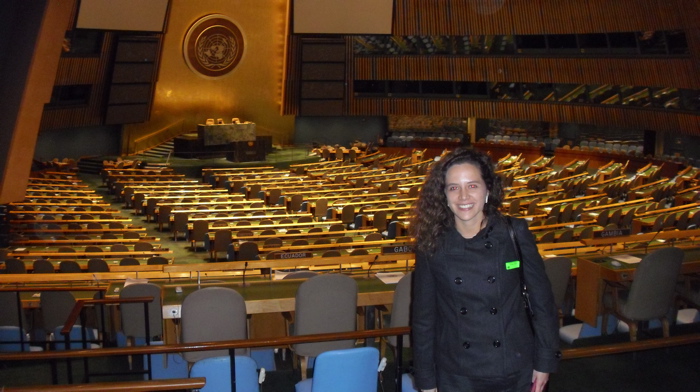
My Master in Business Administration at Toulouse Business School trained me to look past surface-level performance – to ask not only what a system produces, but what structure is producing it. The United Nations gave me something different: the ambition that comes from understanding what well-designed systems, rigorously implemented, could actually change. In the Department of Economic and Social Affairs, Statistics Division, at UN Headquarters in New York, I worked at the source of the indicators governments use to define development, measure poverty, track environmental performance, and assess social protection systems.
It was policy at its most rigorous – the kind that eventually becomes a ratified convention, a national regulation, or a corporate compliance standard passed down through a supply chain. And it gave me something I still carry: the conviction that a well-designed system, taken seriously, can genuinely reshape people’s lives at a scale most of us never witness directly. A worker’s safety might depend on a standard drafted an ocean away. A family living in a stilt house over contaminated water might have a subsidized tariff meant to reach them that never quite does – not because the policy failed, but because no one had verified, in years, who the system was actually still serving.
What the UN also gave me, over time, was a clear-eyed view of the distance between where policy is written and where it lands – between the treaty signed in a conference room and the community it was meant to reach. That distance did not discourage me. It redirected me – toward the University of Amsterdam, where I completed a Master in International Development, to sit at the intersection of rigorous frameworks and the questions those frameworks are ultimately trying to answer. How do you design systems that actually reach the people they are meant to serve, rather than stopping at the level of the institution supposed to deliver them?
That question took me out of the international sphere where policy is written, and into the field where it either becomes real implementation – or doesn’t. That is the space where this series begins.
Stephanie Leroux | Founder & Principal, WAVES Consulting Solutions
wavescs.com | sleroux@wavescs.com