
On Doughnut Economics, scale, and what most growth metrics fail to capture.
Stephanie Leroux
Sustainability & Compliance Specialist | Former UN Secretariat | ISO 9001 • 14001 • 45001 | EN • FR • ES • PT
Blog #2 | WAVES Consulting Solutions
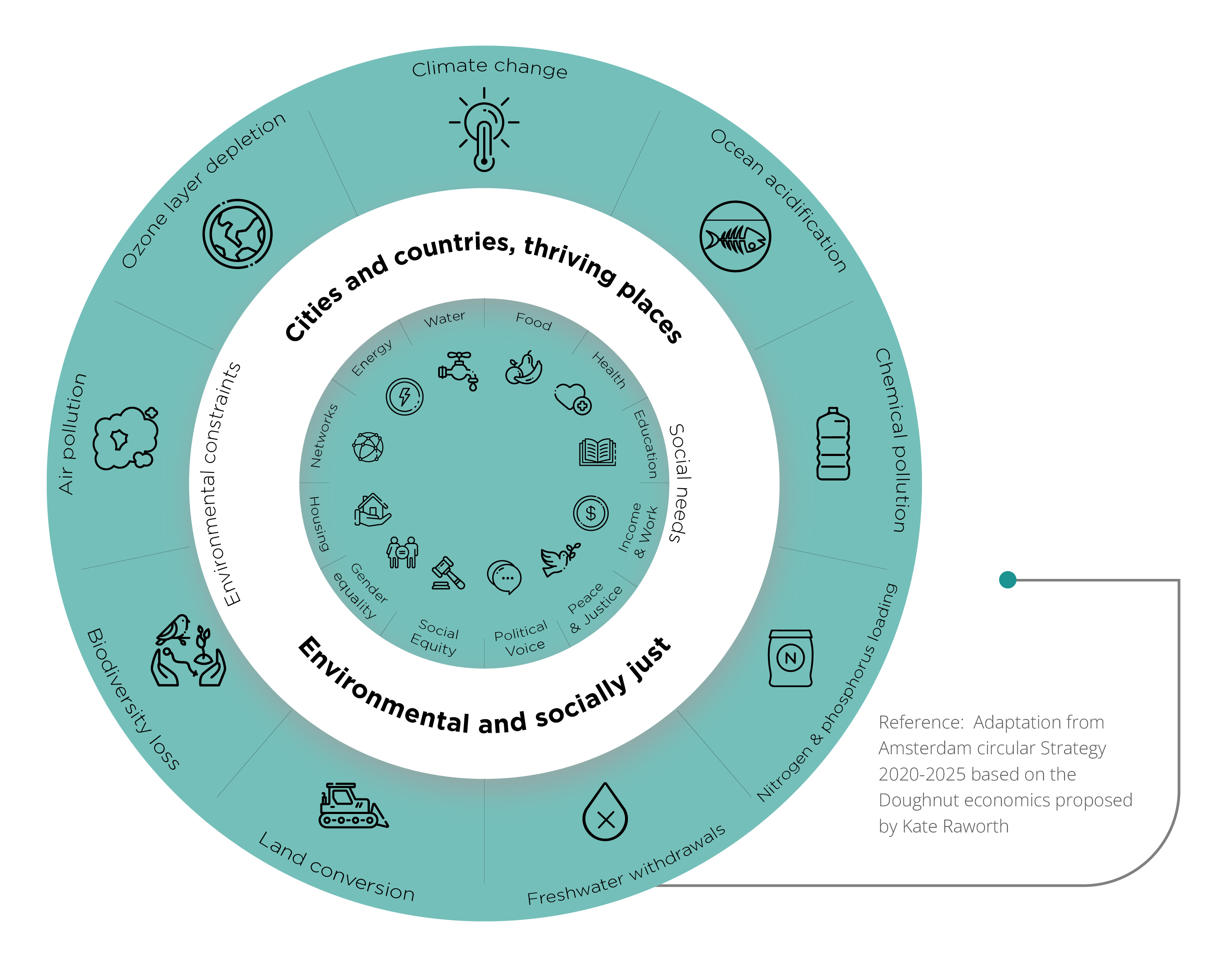
IIn 2017, I was living in Amsterdam when Kate Raworth published Doughnut Economics. Three years later, Amsterdam became the first city in the world to officially adopt it – building Raworth’s framework into the heart of its Circular Strategy 2020–2025, developed in direct collaboration with Raworth herself. The city had been shown how far it sat from living inside the doughnut. It decided to act on what it saw.
What struck me when I first read the book was not the framework itself, but the question underneath it: where does this growth actually sit, relative to the floor and the ceiling? That question turns out to be more useful – and more difficult to answer honestly – than almost any metric conventional reporting provides. Analysis of this gap tends to show the difficulty is not technical at all. It is that the organisations most visibly committed to sustainability are often also producing at the scale that makes the ceiling most relevant. The values are real. The volume is also real. Conventional reporting has no place to put either.
The two boundaries, and what stands behind them
Raworth’s social foundation draws from internationally agreed minimums for human wellbeing: water, food, health, education, income, housing, political voice, and equity. Her ecological ceiling draws on the Planetary Boundaries framework, published in 2009 by Johan Rockström and colleagues at the Stockholm Resilience Centre – nine Earth- system processes, from climate change to biodiversity loss, with quantified thresholds within which human development can continue without destabilising the systems that support it. The most recent assessments indicate several of those boundaries have already been crossed.
What makes this framework useful in practice, rather than simply descriptive, is that both boundaries are measurable. This is what distinguishes it from a values statement: it converts two normative commitments – no one left behind, no ecological overshoot – into a set of indicators that can be tracked over time. What I find most useful about it, working across compliance systems built for other purposes, is that it does not ask an organisation to adopt a new value. It asks whether the values already claimed have a floor and a ceiling attached to them, and whether either is being tracked. As Raworth put it, the framework offers a blueprint that cities and organisations can adapt and adopt to their own context, rather than a fixed prescription. Amsterdam’s experience bore that out: the city translated the global doughnut into a localised City Portrait, then used that portrait to set concrete targets, mobilise institutions, and hold itself to account.
The scale problem
Neither boundary is visible at the scale at which most decisions are made. Industrial or municipal wastewater discharged without adequate pretreatment registers, at the point of discharge, as a routine outflow. The cumulative effect on a receiving water body – eutrophication, loss of aquatic biodiversity, contamination of downstream sources – is determined not by any single discharge event but by the aggregate over time.
This is a common pattern in certification and environmental audits, where environmental permits – discharge permits among them – are checked as one subsection of the regulatory compliance review, when an operation’s activities touch on them. A facility passes every individual check on the books, correctly logged and within permitted range, while the water body it shares with others absorbs an aggregate no single check was designed to capture. Every actor can point to a clean audit. The receiving water body cannot point to anything. That is the gap the doughnut is built to see, and one that conventional compliance frameworks, ISO systems included, are not: they are architected around the single facility, the single event, the single reporting period. The aggregate simply isn’t the unit anyone is measuring. It is the gap that surfaces whenever individual compliance records are correlated against the condition of the receiving system as a whole.
The same logic applies to resource consumption, emissions, and social exclusion: each instance may appear marginal; the aggregate defines the outcome. The underlying economic problem is consistent: the unit at which a decision is made and the unit at which the consequence accumulates operate at entirely different scales. Conventional accounting – and most management-system standards – is built around the first. Financial reporting measures the quarter; a discharge, an emission, a displacement accumulates on a timescale no quarter was built to see. The planetary boundaries and the social foundation are defined at the second. Doughnut Economics is, among other things, an attempt to build a measurement framework that operates at the scale where consequences actually accumulate.
Two sides of one question
Where this framework becomes most useful is in contexts where social and environmental performance are managed as separate functions – separate budgets, separate reporting lines, separate accountability structures. The doughnut asks a single diagnostic question that cuts across all of them: what is this activity actually doing to the floor and the ceiling? That question tends to surface things that departmental reporting, by design, does not. I find it a more honest starting point than most compliance frameworks offer, precisely because it does not let a single good result stand in for the whole picture.
It is not a constraint on ambition. It is a way of making ambition legible – of asking, for any given plan or commitment, what it is costing in ecological terms, in social terms, or both. Set side by side often enough, the floor and the ceiling stop looking like opposing forces and start looking like the same argument: that development only counts if it holds for everyone, within a planet that remains capable of supporting it.
References
Raworth, K. (2017). Doughnut Economics: Seven Ways to Think Like a 21st-Century Economist. Chelsea Green Publishing.
Rockström, J. et al. (2009). Planetary Boundaries: Exploring the Safe Operating Space for Humanity. Ecology and Society, 14(2).
Sen, A. (1999). Development as Freedom. Oxford University Press.
Stephanie Leroux | Founder & Principal, WAVES Consulting Solutions
wavescs.com | sleroux@wavescs.com